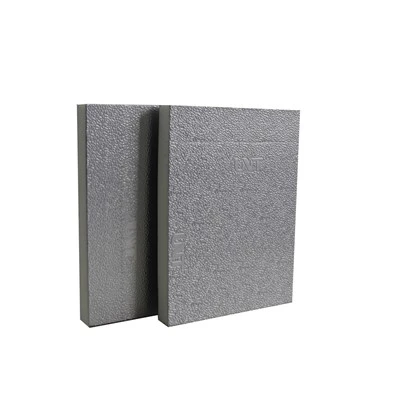


Thanks to its excellent products and quality services, UNT Duct is one of the leading pir foam composite panels manufacturers and suppliers in China. Welcome to buy the high quality and customized products from our factory. We will offer you the best service and fast delivery.
PIR Foam Composite Panels
PIR foam composite panels feature a rigid polyisocyanurate foam core sandwiched between metal or fabric facings, offering superior thermal insulation (λD as low as 19 mW/m·K), excellent fire resistance (up to 60 minutes), and lightweight structural strength-ideal for roofs, walls, and cold storage applications
Structure: Silver Aluminum/ PIR Foam/ Silver Aluminum
Size: 4000*1200*20mm
Foam Density: 50kg/m3
Aluminum Thickness: 0.06mm or 0.08mm
Aluminum Color: Silver
Packing: 10 sheets/ package
Loading Capacity: 710 sheets/ 40'HQ (packed with plastic bags)
660 sheets/ 40'HQ (packed with cardboard box)

Fire Resistance of PIR Foam Composite Panels: Flame retardancy ≠ non-combustibility

One of the most talked-about advantages of PIR is its fire resistance. The decomposition temperature of PIR is approximately 260°C, significantly higher than that of PUR at 220°C. When exposed to fire, a carbonized layer forms on the surface, which slows down the spread of the flame. The PIR composite board foamed with pentane can achieve a fire resistance duration of 30 to 60 minutes.
However, it is essential to recognize clearly: PIR is a "flame-retardant" material, not an "inflammable" one. Compared to rock wool (with a melting point over 1000°C and truly non-flammable), PIR still burns and releases heat and smoke during a fire. Studies have shown that the average FED (Fractional Effective Dose) values of PIR and SPU in fire simulation reach 2.0 or higher, which is considered "very dangerous". The fire resistance grade B1 (difficult to ignite) of PIR is excellent in practical engineering, but it should not be misinterpreted as "not flammable". In places with extremely high fire safety requirements (such as high-rise buildings and densely populated facilities), designers still need to carefully evaluate the combination schemes of PIR with other non-flammable materials, rather than regarding PIR as the universal solution to fire prevention.
The B-side of Environmental of PIR Foam Composite Panels
The advantages of PIR composite boards often mentioned in environmental publicity include: no CFC and HCFC, the use of eco-friendly foaming agents such as pentane, and some products containing recycled materials. These are facts, but the environmental story of PIR is far from complete.
Currently, PIR insulation boards have not achieved complete recycling. PIR foam, as a thermosetting material, is difficult to melt and regenerate like thermoplastic materials. One of the biggest challenges faced by the industry is how to reduce the LCA (Life Cycle Analysis) values of PIR, making it more sustainable. Fortunately, some enterprises have begun to explore the conversion of waste PET into PIR foam polyol raw materials and adding up to 20% recycled components to the polyol blends. But these are still in the early stages. From "green foaming" to "green full life cycle", PIR still has a long way to go.

The Long Run of Durability of PIR Foam Composite Panels

The reference service life of PIR composite boards under normal usage conditions can reach 40 to 50 years. But this promise is based on "correct installation" and "normal usage".
In actual engineering, the durability of PIR composite boards is affected by multiple factors: improper joint treatment may lead to water vapor penetration; although the closed-cell structure can resist moisture, it is not absolutely waterproof; long-term heat aging will cause the foaming gas to slowly diffuse, and the thermal resistance value will decrease over time; the bonding force between PIR and the facing material is only about 1/2 of that of PUR, and there is a risk of detachment under long-term load or temperature cycling. In addition, PIR has limited resistance to ultraviolet rays, and reliable surface layer protection is required in outdoor applications. When evaluating the product lifespan, users should take into account installation quality, maintenance conditions, and environmental factors, rather than relying solely on data from laboratory conditions.
Why choose UNTDuct

What is UNTDuct System

PRE-INSULATED DUCT vs G.I. DUCTWORK
|
Metric |
20mm PIR Pre - Insulated Duct |
0.5mm G.I Duct + 30mm Rubber Plastic (40-90kg/m3) |
|
Fire Safety |
Compliant (Class 0/BS 476, AS 1530.3). Self-extinguishing PIR core, low toxic smoke, non-combustible alu foil. |
G.I non-combustible; |
|
Thermal Insulation |
Excellent. |
Fair. |
|
Hygiene & Air Quality |
Superior. |
Poor. |
|
Lightweight |
1.4-1.5 kg/m². |
5.1–6.3 kg/m². |
|
Energy Efficiency |
Excellent. |
Low. |
|
Ease of Construction |
Easy. |
Complex. |
|
Quiet Operation |
Good. |
Fair. |
|
Space Savings |
Excellent. |
Poor. |
|
Environmental Friendliness |
Balanced. |
Low. |
|
Air Leakage |
Superior. |
Poor. |
Performance comparison based on UNT Duct product data and standard system configurations. Actual performance may vary depending on system design, installation method and project conditions.
How To Make PIR Pre-insulated Straight Duct

Step 1 - Tracing: outline the duct shapes on the panel.
Step 2 - Cutting: Using manual cutting tools, cut along the panel edges and create 90 degree "V" grooves on the panel.
Step 3 - Gluing: Apply glue to the cutting surfaces of the panels.
Step 4 - Folding: After the glue is cured, fold the sides toward each other to form the straight duct.
Step 5 - Taping: The tape is applied only to the external seams of the duct where the sides of the panel were joined for air-tightness.
Step 6 - Flanging: After applying glue and positioning the steel angle bracket, process to fit the PVC or aluminum invisible flanges.
Step 7 - Reinforcement: reinforce the duct with an aluminum reinforcement bar and G.I. Shaped disks, if necessary.
Step 8 - Sealing: After the duct is assembled, seal all internal joints hermetically with silicone.
Need the complete fabrication solution?
UNT Duct supplies PIR duct panels, fabrication tools, jointing accessories, reinforcement components and related materials for complete pre-insulated duct fabrication.
Hot Tags: pir foam composite panels, China, suppliers, manufacturers, factory, customized