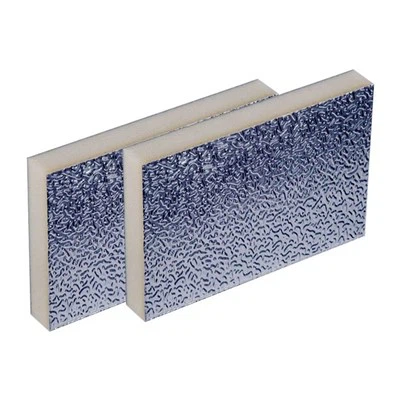


Introduction of PIR Duct Board
PIR foam is formed by the reaction and foaming of isocyanate and polyether under the action of a catalyst. Its closed - cell structure gives the product an extremely low thermal conductivity (about 0.022 W/(m·K)), which effectively blocks heat transfer, ensures the efficient operation of air - conditioning systems and reduces energy consumption. At the same time, this material has high strength and good stability, can withstand a certain amount of pressure and external force, and is not easy to deform. In terms of fire resistance, PIR foam has significant advantages: when burning, a carbonized layer is quickly formed on the surface to block the spread of flames. Most products can reach the flame - retardant B1 grade.


Aluminum foil facing: The most common type, with thicknesses like 60-80μm. Embossed aluminum foil boosts the board's strength and appearance. It has excellent moisture and corrosion resistance, preventing moisture - induced reduction in PIR foam's thermal insulation or mold growth. Also, its smooth surface cuts air flow resistance, enhancing duct ventilation efficiency.
The Advantages of PIR Duct Board
Why It Works Better
1. Consistent Air Temperature, Lower Costs
The PU foam core excels at heat insulation: it keeps cool air from warming in summer and warm air from cooling in winter. This reduces HVAC workload by 30–40%, cutting energy bills significantly for more efficient buildings.
2. Lightweight & Easy to Install
Far lighter than metal ducts, these are easy to maneuver. Pre-cut to standard sizes, they can be quickly trimmed to fit with basic tools. No extra insulation needed-just connect and go. Installation time is halved, slashing labor costs.
3. Durable for Long-Term Use
The closed-cell foam core resists water and mold. Aluminum or steel outer layers prevent rust and dents, even in humid or high-traffic areas. With minimal maintenance, they last 15–20 years without frequent repairs.
4. Fire-Safe Design
Treated with flame retardants, the PU foam slows flame spread and reduces toxic smoke in fires. It meets strict standards (e.g., GB 8624 Class B1), making it safe for homes, offices, and hospitals.
5. Smooth, Clean Airflow
A super-smooth interior minimizes air resistance, boosting HVAC efficiency and reducing energy use. It also resists dust and germ buildup, ensuring cleaner air-ideal for schools, kitchens, and offices.
6. Fits Any Space
Easily shaped into rectangles, circles, or custom forms for tight areas. Suitable for homes, hotels, malls, and small factories-anywhere reliable heating or cooling is needed.
Polyurethane Pre-insulated Duct is the smart choice: easy to install, energy-saving, long-lasting, and air-purifying. It works as hard as your building does.
Installation and Maintenance Points
Marking: Make proper marks on the PIR duct board according to design and on-site requirements.
Cutting: Use professional tools to accurately cut the board along the marks.
Gluing: Apply special glue evenly on the joint areas of the boards.
Folding: Fold the glued boards into the shape of a duct.
Taping: Apply tape on the seams to enhance airtightness.
Installing profiles: Fit special profiles to further reinforce the duct.

How to make Air Ducts with PIR Duct Board
The fabrication process of Pre-insulated Air Ducts


(II) Maintenance Points
Regular Inspection: Check for panel damage, dampness, loose connections, and poor sealing. Repair promptly to avoid impacting system performance.
Cleaning & Maintenance: Regularly clean duct interiors with professional equipment (e.g., duct cleaning robots) to maintain airflow and air quality. Avoid damaging panels with sharp tools.
Environmental Monitoring: Monitor temperature and humidity around ducts; avoid prolonged exposure to high heat, humidity, or corrosive conditions. Take timely protective measures (e.g., adding moisture-proof/anti-corrosion layers) if needed.
Hot Tags: pir duct board, China, suppliers, manufacturers, factory, customized