

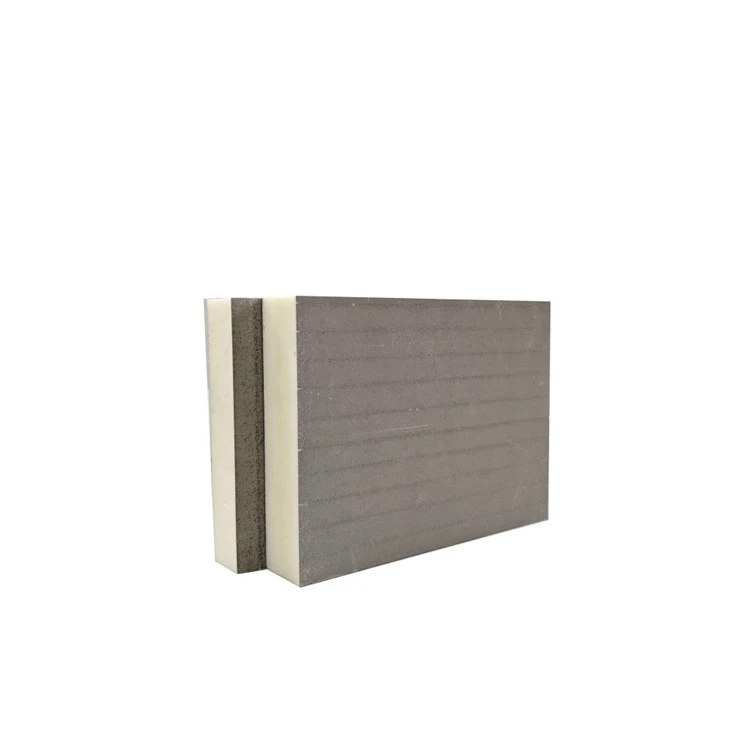
In modern construction and industrial applications, thermal insulation materials play a pivotal role in energy efficiency, environmental sustainability, and structural performance. Among the advanced solutions gaining traction, the Double-Sided Glass Fiber Heating Thermal Insulated Rigid Core Foam Panel stands out for its unique combination of thermal resistance, mechanical strength, and specialized heating functionality.
Available in thicknesses ranging from 15mm to 80mm (15, 20, 25, 30, 40, 50, 60, 70, 75, 80mm), this panel is designed to meet diverse insulation needs across residential, commercial, and industrial sectors.
1. Core Composition & Structural Design of Fiber Glass Wall Insulation Board

1.1. Layered Architecture
Inner Rigid Core Foam Layer: Typically composed of polyurethane (PUR) or polyisocyanurate (PIR) foam, renowned for their exceptional thermal conductivity (λ-values as low as 0.020-0.025 W/m·K). The foam density ranges from 30-45 kg/m³, balancing insulation efficiency with structural rigidity.
Double-Sided Glass Fiber Reinforced Layers: Each side is laminated with a woven glass fiber mat or non-woven glass fiber tissue.
1.2 Thickness Versatility
15-30mm: Suitable for internal partitions, light commercial buildings, or retrofitting projects where space is limited.
40-60mm: Ideal for exterior walls, roofs, and floors in residential homes, offering a balance of insulation and cost-effectiveness.
70-80mm: Used in industrial facilities, cold storage warehouses, or extreme climate zones requiring ultra-high thermal performance (R-values up to 7.0 m²·K/W for 80mm thickness).
2. Key Technical Features & Performance Metrics of Fiber Glass Wall Insulation Board
2.1 Thermal Insulation Efficiency
Low Thermal Conductivity: The rigid foam core minimizes heat transfer, while the glass fiber layers act as a thermal barrier, reducing thermal bridging.
Thermal Resistance (R-value): Calculated as thickness (m) divided by λ-value. For example, a 50mm panel with λ=0.023 W/m·K has an R-value of ~2.17 m²·K/W, exceeding most building code requirements for energy-efficient structures.
2.2 Mechanical Properties
Compressive Strength: Ranges from 150-300 kPa, depending on thickness and density, making it suitable for load-bearing applications (e.g., floor insulation under concrete slabs).

Hot Tags: fiber glass wall insulation board, China, suppliers, manufacturers, factory, customized