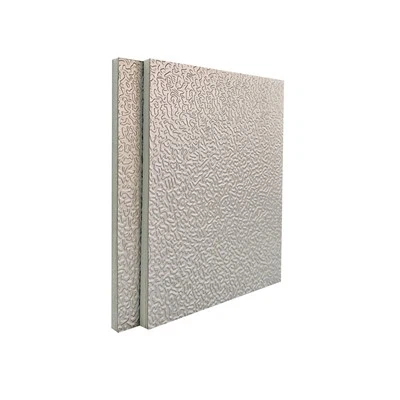


Thanks to its excellent products and quality services, UNT Duct is one of the leading pir foam aluminium foil duct board manufacturers and suppliers in China. Welcome to buy the high quality and customized products from our factory. We will offer you the best service and fast delivery.
PIR foam Aluminium Foil Duct Board
UNTDuct PIR foam Aluminium Foil Duct Board is a premium solution for high-efficiency ventilation and HVAC systems.
Built around a rigid PIR foam core with double-sided aluminum foil layers, the panel achieves excellent thermal resistance to block heat transfer and maintain steady duct temperatures.
Apart from reliable thermal insulation, it features great durability to withstand harsh operating and environmental conditions for long-term stable service.
Thanks to its innovative design, the panel greatly reduces energy loss, improves the overall efficiency of HVAC equipment, and helps users save operational costs while lessening environmental impact.
Panel Structure: Silver Alu. Foil/ PIR Foam / Silver Alu. Foil
Foam Density: 52kg/m3
Standard Size: 3950mm*1200mm
Thickness: 20mm
Alu. Foil: 60 or 80 Micron
Packing: 10 sheets/ package
PIR ALU Pre-insulated Duct Panels
are also available with thickness 10, 12, 15, 20, 25, 30, 40mm.

How do PIR foam Aluminium Foil Duct Board reduce condensation risk and keep sustained energy efficiency?

PIR foam Aluminium Foil Duct Board significantly reduce condensation risk thanks to their excellent thermal insulation performance and airtight aluminum foil facings.
PIR foam has extremely low thermal conductivity, which maintains the duct surface temperature close to the internal air temperature. This minimizes the temperature difference between the duct and ambient air, preventing the surface from dropping below the dew point-the key cause of condensation.
Additionally, the fully sealed aluminum foil layers block moisture penetration from the surrounding environment, while precise joint design eliminates air leakage. This prevents humid air from contacting the cold core, further reducing condensation.
Less condensation means no moisture accumulation, no mold growth, and no degradation of insulation performance over time. The duct system maintains stable thermal resistance, avoiding increased heat loss caused by damp or damaged insulation. As a result, HVAC energy consumption remains consistently low, ensuring sustained energy efficiency throughout the system's service life.
Limitation Analysis of PIR foam Aluminium Foil Duct Board
Despite its outstanding performance, the PIR foam Aluminium Foil Duct Board also faces some practical challenges that limit its widespread application:
Cost barrier: The synthesis process of PI monomers is complex, resulting in their raw material costs being much higher than those of PIR, phenolic, or melamine foams. This makes them uncompetitive in the cost-sensitive general commercial building HVAC market.
Competitive material pressure: Under non-extreme conditions, melamine foam performs well in sound absorption and fire resistance with lower costs; high-performance PIR foam has advantages in insulation efficiency (thermal conductivity can be as low as 0.018-0.022 W/mK) and cost. The unique value of PIF foam can only be fully demonstrated in scenarios where it is "unreplaceable".
In conclusion, the PIR foam Aluminium Foil Duct Board is a high-end product with the core value of supreme safety and environmental adaptability. Its decision-making logic does not lie in cost considerations, but rather in the rigid demands for extreme temperatures, strict fire protection, low gas release, etc.

Full Life Cycle Carbon Emissions of PIR foam Aluminium Foil Duct Board

Operational energy consumption carbon data:
The thermal conductivity of PIP ceramic materials is 0.018–0.022 W/(m・K), the thermal conductivity of the metal duct composite insulation is 0.033 W/(m・K), and the difference in heat loss between hot and cold is 33%. The annual electricity consumption of the air conditioning system in a 10,000-square-meter commercial complex is reduced by 8%–12%, and the annual carbon emissions are approximately 42 tons; calculated at the domestic carbon trading average price of 55 yuan/ton, the annual carbon cost savings are 2,310 yuan, and the cumulative carbon reduction over a 20-year usage period is 840 tons, with a carbon revenue exceeding 46,000 yuan.
Production and scrap carbon difference:
PIP is integrated prefabrication, formed in the factory at one time, and the production carbon emissions are 27% lower than the "single processing of iron sheets + outsourcing of insulation" process; PIP has no metal rusting solid waste, and after scrap, the foam core material can be recycled and reprocessed, while the metal duct rusts and can only be completely discarded, with the carbon emissions from solid waste treatment being 41% higher.
certification of PIR foam Aluminium Foil Duct Board
Fire Safety, Thermal Conductivity and Physical Performance

BS 476 Part 6&7

ASNZS 1530.3

thermal Conductivity

Compress Strength

CFC HCFC Free
Hot Tags: pir foam aluminium foil duct board, China, suppliers, manufacturers, factory, customized