

Thanks to its excellent products and quality services, UNT Duct is one of the leading pir air conditional panels manufacturers and suppliers in China. Welcome to buy the high quality and customized products from our factory. We will offer you the best service and fast delivery.
PIR Air Conditional Panels
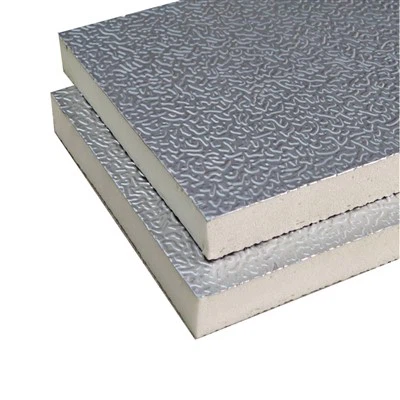
PIR Air Conditional Panels represent a high-performance core solution for contemporary HVAC systems. Featuring an integrated sandwich structure with aluminium foil facings and a rigid PIR foam core, they deliver superior performance compared to conventional galvanised steel ducts that demand on-site insulation treatment. Suited for an extensive variety of projects, these duct panels are commonly specified for hotels, office complexes, airports, hospitals, as well as other commercial and public facilities.
Core Material: Rigid polyisocyanurate (PIR) foam featuring a high closed-cell ratio (generally over 90%).
Facings: Both surfaces are laminated with reinforced aluminium foil, fiberglass scrim or other vapour retarder layers to deliver enhanced durability, thermal reflectivity and a smooth airflow surface.
Available Thickness: 10 mm, 20 mm, 25 mm, 30 mm, 40 mm

Why Choose PIR Air Conditional Panels?

Thermal Insulation, Low Smoke Emission and Low Toxicity
When it comes to fire safety, PIR foam features intrinsic flame-retardant characteristics. Its Limiting Oxygen Index (LOI) generally exceeds 34%, greatly outperforming the criteria for most conventional flame-resistant materials.
Outstanding Acoustic & Thermal Insulation
PIR foam adopts an open-cell structure with an open-cell ratio reaching up to 99%. This delivers remarkable sound absorption performance, achieving a Noise Reduction Coefficient (NRC) of up to 0.54 across the 125–4000 Hz frequency band. It effectively mitigates airflow noise and equipment operational noise within HVAC systems. Moreover, its thermal conductivity stands below 0.022 W/(m·K), offering dependable thermal insulation while maintaining low weight.
Ultra-Low Outgassing and Superior Chemical Stability
Under vacuum conditions, volatile emissions from materials pose contamination risks to precision instruments. Benefiting from ultra-low outgassing performance, PIR foam is extensively applied in aerospace and semiconductor cleanroom settings. Furthermore, it resists corrosion from weak acids, weak alkalis and common oils including 93# gasoline, showcasing robust chemical stability.
Service Life, Environmental Protection and Hygiene of PIR Air Conditional Panels
Durability Performance Indicators
Benefiting from the stable cyclic macromolecular structure of PIR foam in PIR Air Conditional Panels, its thermal conductivity variation is controlled within a maximum increase of 5% across 25 years, with a rated service life of 20–25 years. By contrast, galvanized steel ducts develop corrosion and air leakage after 5–8 years, and rock wool will pulverise and lose its insulating function within 5 years. The overall life-cycle replacement cost can be lowered by 70%.
Environmental Test Outcomes
No harmful substances such as formaldehyde or benzene are released, and asbestos is absent from the formulation. The material loss rate during foaming production stands at only 3%, and residual scraps are recyclable for secondary manufacturing. The product meets requirements to gain bonus credits for LEED certification and China Three-Star Green Building Evaluation.
Cleanliness Characteristics
The smooth antibacterial aluminium foil cladding on both sides reduces internal air flow resistance by 12% and inhibits dust accumulation and mould growth. It is applicable to purified ventilation systems for food factories and surgical operating rooms. Extra antibacterial inner lining coating is unnecessary, resulting in zero additional consumable costs for clean system construction.

Why choose UNTDuct

Project Case of UNT Ductwork

Specification
|
Item |
Unit |
Specification |
|
Standard Panel Size |
mm |
3950x1200x20 |
|
Alu. Foil Thickness |
mm |
0.06 or 0.08 |
|
Foam Density |
kg/m³ |
50-55 |
|
Fire Safety (BS476Part 6&7) |
|
Class 0 |
|
Thermal Conductivity |
W/(m·K) |
0.020 |
| Compressive Strength |
MPa |
0.2 |
|
Bending Strength |
MPa |
2 |
|
Water Absorption |
% |
0.36 |
|
Dimension Change |
% |
0.3 |
|
Working Temperature |
℃ |
-60 to +80 |
|
Max Pressure in duct |
Pa |
1500 |
|
Maximum Allowable Wind Velocity |
m/s |
≤15 |
|
Max Continuous Running Temperature |
℃ |
≤70 |
|
Lifespan of PIR Air Duct |
years |
>20 |
PRE-INSULATED DUCT vs G.I. DUCTWORK
|
Metric |
20mm PIR Pre - Insulated Duct |
0.5mm G.I Duct + 30mm Rubber Plastic (40-90kg/m3) |
|
Fire Safety |
Compliant (Class 0/BS 476, AS 1530.3). Self-extinguishing PIR core, low toxic smoke, non-combustible alu foil. |
G.I non-combustible; |
|
Thermal Insulation |
Excellent. |
Fair. |
|
Hygiene & Air Quality |
Superior. |
Poor. |
|
Lightweight |
1.4-1.5 kg/m². |
5.1–6.3 kg/m². |
|
Energy Efficiency |
Excellent. |
Low. |
|
Ease of Construction |
Easy. |
Complex. |
|
Quiet Operation |
Good. |
Fair. |
|
Space Savings |
Excellent. |
Poor. |
|
Environmental Friendliness |
Balanced. |
Low. |
|
Air Leakage |
Superior. |
Poor. |
Performance comparison based on UNT Duct product data and standard system configurations. Actual performance may vary depending on system design, installation method and project conditions.
Hot Tags: pir air conditional panels, China, suppliers, manufacturers, factory, customized