


A. Zinc-Coated Steel Hanger of HVAC Accessories
why choose us
Enhance the efficiency and durability of your industrial HVAC systems with our cutting-edge Zinc-Coated Steel Hangers, the ultimate solution for Metal Steel Ductwork and Pre-Insulated Duct Panel Installation. Crafted with precision and engineered to meet the rigorous demands of industrial environments, these hangers redefine reliability and performance in HVAC system accessories.
Constructed from high-grade steel and fortified with a robust zinc coating, our hangers offer exceptional corrosion resistance, ensuring a prolonged service life even in harsh conditions. The zinc coating acts as a protective shield, preventing rust and oxidation, making these hangers ideal for use in areas with high humidity, chemical exposure, or extreme temperature fluctuations. This superior durability not only reduces maintenance costs but also minimizes the risk of system failures, ensuring uninterrupted operation of your HVAC systems.
Designed for versatility, our Zinc-Coated Steel Hangers are compatible with a wide range of metal steel ductwork and pre-insulated duct panels. Whether you're installing a new HVAC system or upgrading an existing one, these hangers provide a secure and stable support structure, ensuring the proper alignment and positioning of ductwork. Their adjustable design allows for easy installation and customization, accommodating different duct sizes and configurations with ease. This flexibility makes them a perfect choice for various industrial applications, from manufacturing plants and warehouses to commercial buildings and data centers.
Installation of our Zinc-Coated Steel Hangers is a breeze, thanks to their user-friendly design and comprehensive installation kit. The kit includes all the necessary hardware and instructions, ensuring a quick and hassle-free installation process. Whether you're a professional installer or a DIY enthusiast, you'll appreciate the simplicity and convenience of our hangers. Their lightweight yet sturdy construction makes them easy to handle and install, reducing installation time and labor costs.
B. Core installation steps of Zinc-Coated Steel Duct Hanger
Step 1: Fix the suspension rods (load-bearing foundation)
For concrete ceilings: Drill holes at marked points with an impact drill (the hole diameter should be 2mm larger than the diameter of the expansion bolt, and the depth should be ≥ the anchoring length of the expansion bolt), insert the expansion bolt, and tighten the nut to firmly bond the bolt with the base. Connect one end of the suspension rod (with a thread) to the expansion bolt and tighten it with a wrench (the torque should be controlled at 25-30N · m to prevent the bolt from stripped).
For steel structure ceilings: Directly use an electric wrench to pre-drill holes in the self-tapping steel structure bolts through the suspension rods, and fix them on the steel beams to ensure that the bolts are fully embedded in the steel beams (exposed threads ≤2 teeth).
Adjust the length of the hanger: According to the installation height of the air duct, adjust the pendant length of the hanger through the adjusting nut on the hanger, and reserve the installation space for the crossarm (usually 50mm lower than the bottom elevation of the air duct).
Step 2: Install the crossarm and the clamp
Connect the crossarm (horizontal support rod) to the hanger rod: Pre-drill holes at both ends of the crossarm, insert the hanger rod, and fix the crossarm with double nuts (one at the top and one at the bottom) to ensure the crossarm is level (calibrate with a level, the level deviation is ≤1mm/m).
Install clamps (to enhance fixation stability) : For circular air ducts or rectangular air ducts with a side length greater than 500mm, install galvanized steel clamps that match the shape of the air duct on the crossarm. Rubber pads (3-5mm thick) can be pasted on the inner side of the clamps to prevent noise caused by the vibration of the air duct and the friction between the clamps. Tighten the clamp bolts to ensure that the clamp is closely attached to the air duct (the force should be such that the air duct does not become loose or deformed).
Step 3: Positioning and adjustment of the air ducts
Multiple people should cooperate to lift the air duct onto the crossarm/clamp, ensuring that the centerline of the air duct aligns with the reference line of the hanger. For multi-section spliced air ducts, first fix the hangers at both ends, then adjust the hangers in the middle to make the splicing seams of the air ducts smooth (the gap ≤1mm).
Check the overall levelness of the air ducts with a level (the horizontal deviation of rectangular air ducts is ≤3mm/m, that of circular air ducts is ≤2mm/m), and the verticality deviation of vertical air ducts is ≤2mm/m. If there is a deviation, correct it by adjusting the position of the boom nut or the crossarm.
Step 4: Reinforcement and anti-corrosion treatment
For heavy air ducts or parts with additional loads (such as installing fire dampers on air ducts), "diagonal braces" (forming a triangular structure with the hangers and ceiling) are added below the crossarms. The two ends of the diagonal braces are respectively fixed with bolts to enhance the stability of the hangers.
Repair zinc coating: Use an Angle grinder to grind the zinc coating area that was scratched during installation. After cleaning the dust, apply anti-rust paint (at least 2 coats, with a 2-hour interval) to prevent the base material from rusting.
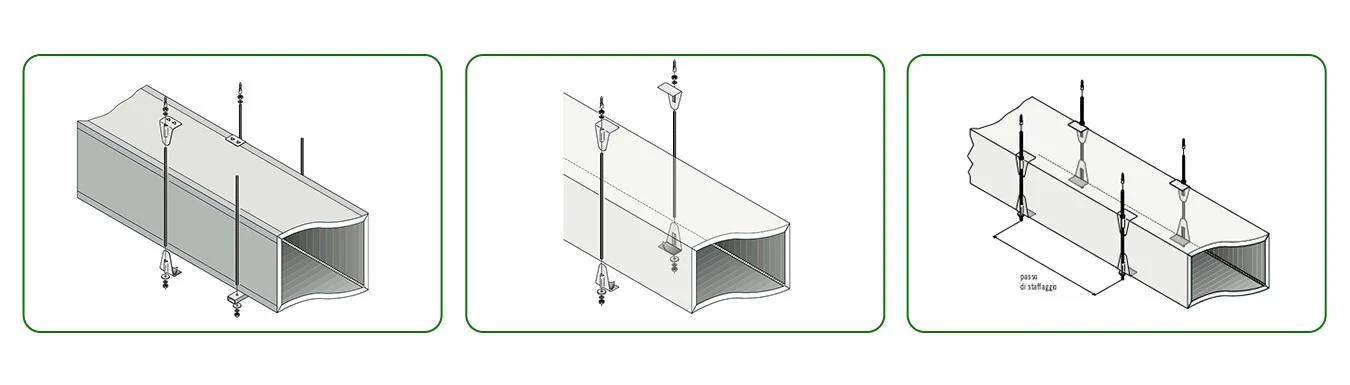

Zinc-coated Steel Hanger

Hot Tags: Zinc-Coated Steel Duct Hanger, China, suppliers, manufacturers, factory, customized


