


Thanks to its excellent products and quality services, UNT Duct is one of the leading pu air ducting manufacturers and suppliers in China. Welcome to buy the high quality and customized products from our factory. We will offer you the best service and fast delivery.
PU Air Ducting
PU Air Ducting, also referred to as PU aluminum foil duct board or PU sandwich air duct panel, is a high-performance composite material specially engineered for HVAC heating, ventilation and air conditioning ductwork systems.
The panel features a three-layer bonded composite structure:
Two outer faces: Heavy-duty aluminum foil, available in smooth or embossed finishes
Central core: Rigid polyurethane (PU) foam, serving simultaneously as structural reinforcement and thermal insulation
Structure: Silver Aluminum/ PU Foam/ Silver Aluminum
Size: 3950*1200*20mm
Foam Density: 40-45kg/m3
Aluminum Thickness: 0.06mm or 0.08mm
Aluminum Color: Silver
Packing: 10 sheets/ package
Loading Capacity: 710 sheets/ 40'HQ (packed with plastic bags)
660 sheets/ 40'HQ (packed with cardboard box)

System Cost Perspective of PU Air Ducting
The hidden benefits of installation efficiency:
The extremely low density of PU foam panels results in their weight being only a fraction of that of traditional metal ducts and external insulation systems. This means that in high-rise buildings or large factories, the structural load design grade can be significantly reduced, the lifting and support systems can be simplified, and the saved steel and labor costs often offset the material premium.
Long-term reduction of energy consumption through dimensionality reduction:
The PU foam can maintain an extremely low thermal conductivity (≤ 0.022 W/mK at room temperature) over a wide temperature range (-200°C to above +200°C), and its performance degrades very slowly. Traditional insulation materials (such as glass wool) will have their thermal conductivity soar after getting wet, while the hydrophobicity and closed-cell ratio of PI ensure the long-term stability of its thermal performance in humid and hot environments. When the energy loss over 20 years of operation is factored into the initial cost, the PI solution has a significant advantage in terms of life cycle economics.
Are there any limitations or precautions for using PU Air Ducting?

Main Limitations
1. Not suitable for long-term high-temperature environment above 120℃
2. Poor resistance to strong acid, alkali and organic solvent erosion
3. Lower impact resistance compared with metal ducts, easy to crack under heavy collision
4. Not applicable for high-pressure wind pipe systems with extreme air pressure
Usage Precautions
1. Avoid direct exposure to open flame and high heat sources during installation and use
2. Keep away from corrosive chemical gas and liquid contact
3. Store panels in dry, cool place, prevent long-term sun exposure and rain soaking
4. Cut and construct with professional tools, avoid violent bending and extrusion
5. Strictly follow standard installation process to ensure joint sealing effect
6. Do not use in special flammable and explosive industrial ventilation occasions
Why choose UNTDuct

FAQ of UNTDuct

PRE-INSULATED DUCT vs G.I. DUCTWORK
|
|||||||||||||||||||||||||||||||||||
| Performance comparison based on UNT Duct product data and standard system configurations. Actual performance may vary depending on system design, installation method and project conditions. |
How To Make PU Pre-insulated Straight Duct
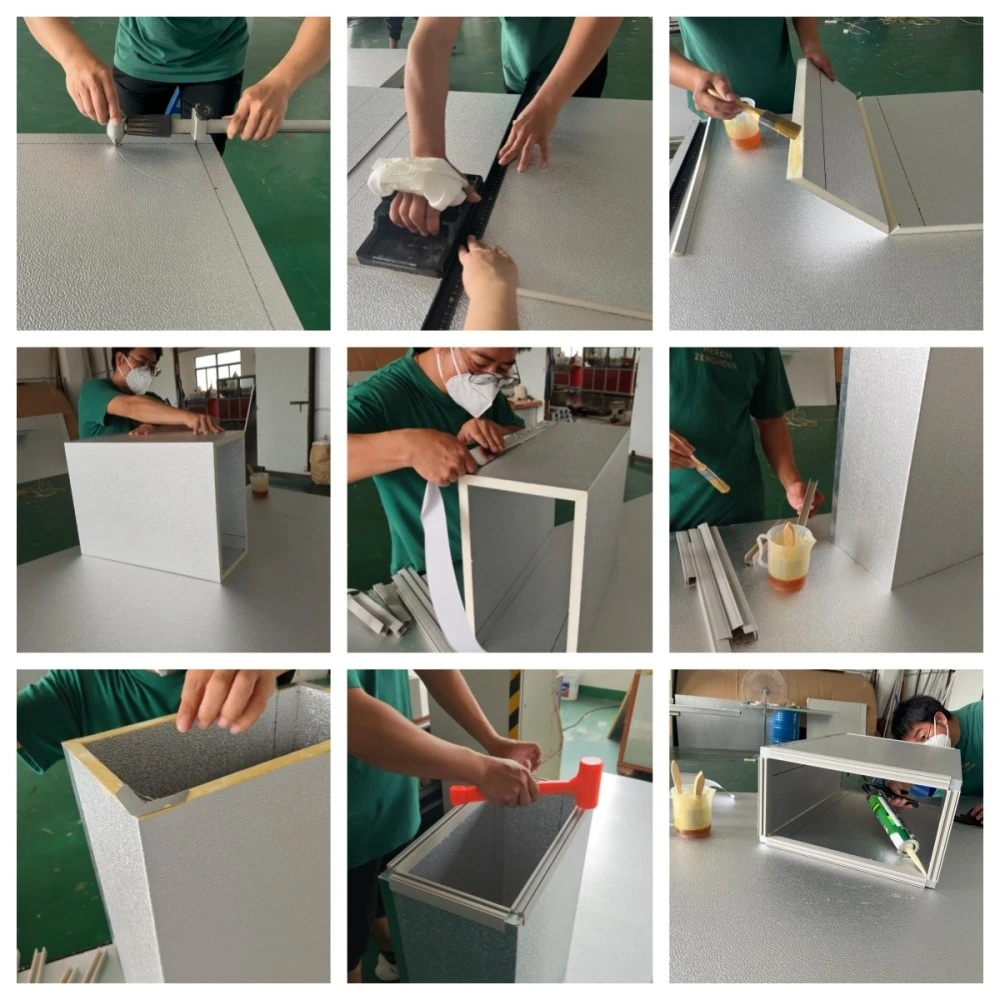
Step 1 - Tracing: outline the duct shapes on the panel.
Step 2 - Cutting: Using manual cutting tools, cut along the panel edges and create 90 degree "V" grooves on the panel.
Step 3 - Gluing: Apply glue to the cutting surfaces of the panels.
Step 4 - Folding: After the glue is cured, fold the sides toward each other to form the straight duct.
Step 5 - Taping: The tape is applied only to the external seams of the duct where the sides of the panel were joined for air-tightness.
Step 6 - Flanging: After applying glue and positioning the steel angle bracket, process to fit the PVC or aluminum invisible flanges.
Step 7 - Reinforcement: reinforce the duct with an aluminum reinforcement bar and G.I. Shaped disks, if necessary.
Step 8 - Sealing: After the duct is assembled, seal all internal joints hermetically with silicone.
Need the complete fabrication solution?
UNT Duct supplies PU duct panels, fabrication tools, jointing accessories, reinforcement components and related materials for complete pre-insulated duct fabrication.
Hot Tags: pu air ducting, China, suppliers, manufacturers, factory, customized


